Ethiopia stands alone as one of the few countries in the world that measures time and dates by its own unique system. The Ethiopian calendar and time reckoning system are not only fascinating but also deeply tied to the country’s history, culture, and daily life. For travelers, researchers, or anyone intrigued by how societies measure time, delving into Ethiopia’s distinctive approach offers a window into a civilization that has maintained its traditions for centuries. From New Year’s Day falling in September to days starting at sunrise, Ethiopia’s chronology challenges our assumptions about the universality of timekeeping.
The Roots of the Ethiopian Calendar: A Historical Perspective
The Ethiopian calendar, also known as the Ge’ez calendar, traces its origins back to ancient Egypt and shares similarities with the Coptic calendar. Its current form has been used in Ethiopia since at least the 4th century AD, making it one of the oldest continually used calendars in the world.
Unlike the widely used Gregorian calendar, which was introduced in 1582, the Ethiopian calendar is based on the older Julian system. The result is a calendar that is currently about seven to eight years behind the Gregorian calendar. For example, when the world celebrated the start of 2024, Ethiopia was still in the year 2016. This difference arises from alternate calculations of the Annunciation of Jesus, a pivotal event in Christian chronology.

The Ethiopian calendar also has its own names for months and days, all deeply rooted in local languages and religious traditions. It reflects Ethiopia's unique religious history, especially the influence of the Ethiopian Orthodox Tewahedo Church, one of the oldest Christian communities in the world.
How the Ethiopian Calendar Works: Months, Years, and Leap Years
The Ethiopian calendar consists of 13 months: 12 months with 30 days each, and a 13th month called Pagumē with 5 days (or 6 days in a leap year). This structure makes the Ethiopian year exactly 365 days long, with a leap year every four years, just like the Julian calendar.
The months of the Ethiopian year are as follows:
- Mäggabit - Miyazya - Ginbot - Sene - Hamle - Nehase - Meskerem - Tikimt - Hidar - Tahsas - Tir - Yekatit - PagumēThe Ethiopian New Year, Enkutatash, falls on Meskerem 1, which usually corresponds to September 11th on the Gregorian calendar (or September 12th in a leap year). This timing coincides with the end of the rainy season in Ethiopia, symbolizing renewal and hope.
Additionally, the leap year system in Ethiopia operates on a cycle similar to the Julian calendar, adding an extra day to Pagumē every four years. This keeps the calendar in close alignment with the solar year, although it gradually drifts compared to the Gregorian calendar due to the lack of the Gregorian system's century leap-year correction.
Comparing the Ethiopian Calendar to Other Major Calendars
Ethiopia’s method of timekeeping is distinctive, but how does it stack up against other popular calendars used globally? The comparison below highlights key differences and similarities between the Ethiopian, Gregorian, and Coptic calendars.
| Feature | Ethiopian Calendar | Gregorian Calendar | Coptic Calendar |
|---|---|---|---|
| Year Difference (2024 Gregorian) | 2016/2017 | 2024 | 1740/1741 |
| Months in a Year | 13 (12x30 days + 1x5/6 days) | 12 (varying days) | 13 (same as Ethiopian) |
| Days in a Year | 365 or 366 | 365 or 366 | 365 or 366 |
| New Year’s Day | Meskerem 1 (Sept 11/12) | January 1 | Thout 1 (Sept 11/12) |
| Leap Year Cycle | Every 4 years (no century correction) | Every 4 years, except years divisible by 100 but not 400 | Every 4 years (same as Ethiopian) |
| Day Names | Ge’ez/Amharic Names | English/Latin Names | Coptic/Arabic Names |
This comparison underscores Ethiopia’s adherence to ancient timekeeping traditions, while also revealing its calendar’s close kinship to Egypt’s Coptic system.
The Ethiopian Time Reckoning System: Counting Hours from Sunrise
Perhaps even more intriguing than the calendar is Ethiopia’s unique way of telling time. In Ethiopia, the day begins at sunrise, not at midnight or noon. Locally, the clock starts at "one" when the sun rises—typically around 6:00 AM on a Western clock. As a result, Ethiopian time is consistently six hours behind Western-standard time.
To illustrate, when it is 7:00 AM in the Western system, Ethiopians refer to it as 1:00 in the morning. Noon is 6:00, sunset is 12:00, and the night hours follow the same cycle. This approach is sometimes called “Ethiopian time” or “East African time.”
This system is logical in a country near the equator, where sunrise and sunset times do not vary dramatically throughout the year. It also reflects a practical, agrarian sensibility, as daily life historically began with the appearance of the sun.
For visitors and foreigners, this can be a source of confusion. It is common to clarify whether a time is being given “Ethiopian time” or “Western time” when making appointments or travel arrangements.
Religious and Cultural Significance of the Ethiopian Calendar
The Ethiopian calendar is not merely a tool for timekeeping; it is deeply woven into the nation’s religious and cultural life. Almost all major Ethiopian Orthodox Christian holidays are calculated according to the Ethiopian calendar. For instance, Christmas (Genna) falls on Tahsas 29 (usually January 7 Gregorian), and Easter (Fasika) is often celebrated at a different time than Western Easter.
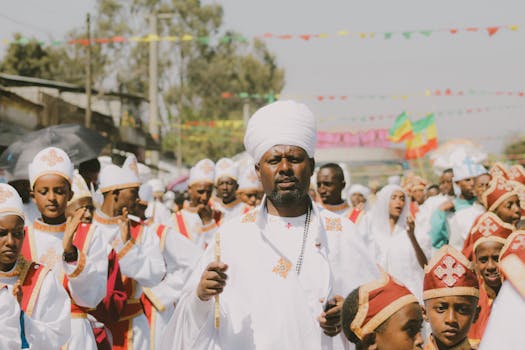
The calendar also shapes secular and agricultural life. Enkutatash, the Ethiopian New Year, is celebrated with flowers, music, and communal gatherings, marking the end of the rainy season and the start of new agricultural cycles. Meskel, another major festival, commemorates the discovery of the True Cross and falls on Meskerem 17 (September 27 Gregorian).
The calendar’s 13th month, Pagumē, holds special cultural significance. Its very name means “forgotten days,” and it is sometimes seen as a time for reflection, spiritual renewal, and tying up loose ends before the new year begins.
The Ethiopian Calendar in Modern Life and Globalization
In today’s interconnected world, Ethiopia’s unique calendar and time system coexist with the international Gregorian calendar. Banks, airlines, and government offices often use both systems side by side. Official documents may refer to both Ethiopian and Gregorian dates, and electronic calendars in Ethiopia can be set to display either system.
This dual-system approach is emblematic of Ethiopia’s balancing act: preserving ancient heritage while engaging with global commerce and communication. It also presents challenges, particularly in international business, tourism, and education, where misunderstandings about dates and times can arise.
Despite these challenges, the Ethiopian calendar remains a vital part of national identity. According to a 2022 survey by the Ethiopian Statistics Service, over 85% of Ethiopians prefer to use their traditional calendar in daily life, especially for family events, religious observances, and local transactions.
Why Ethiopia’s Time System Continues to Fascinate
The Ethiopian calendar and time reckoning system are living testaments to the country’s resilience, cultural pride, and historical depth. While the rest of the world adopted new ways of measuring days and years, Ethiopia held fast to ancient traditions that continue to shape its society today.
For travelers, understanding the Ethiopian calendar is not just a practical necessity—it's a chance to engage more deeply with a culture that values its heritage. For scholars and history buffs, Ethiopia’s time system offers a rare glimpse into how different civilizations have understood the passage of time.
As Ethiopia continues to modernize and connect with the world, its calendar and timekeeping traditions remind us that time is as much a matter of culture as it is of clocks.